
Understanding how academic performance is measured is the primary step toward taking control of a university career. Students frequently discover the mechanics of grading only when facing academic probation or attempting to determine what it takes to graduate with a specific honors classification. Knowing the exact mathematics behind academic records allows individuals to strategize effectively, prioritize study efforts, and eliminate unpleasant surprises at the conclusion of any semester.
While minor administrative variations exist across institutions, the National Universities Commission provides a standardized regulatory framework that forms the operational backbone of grading systems throughout the country. Whether you are a freshman trying to make sense of an initial results sheet or an upperclassman looking to pull a cumulative average into a higher honors bracket, mastering this math is essential for long-term success.
The Foundation: Understanding the 5.0 Grading Scale
Most Nigerian tertiary institutions operate on a standardized 5.0 grading scale. Performance in every registered course is evaluated on a letter grade and point system that translates raw percentage scores into concrete grade points.
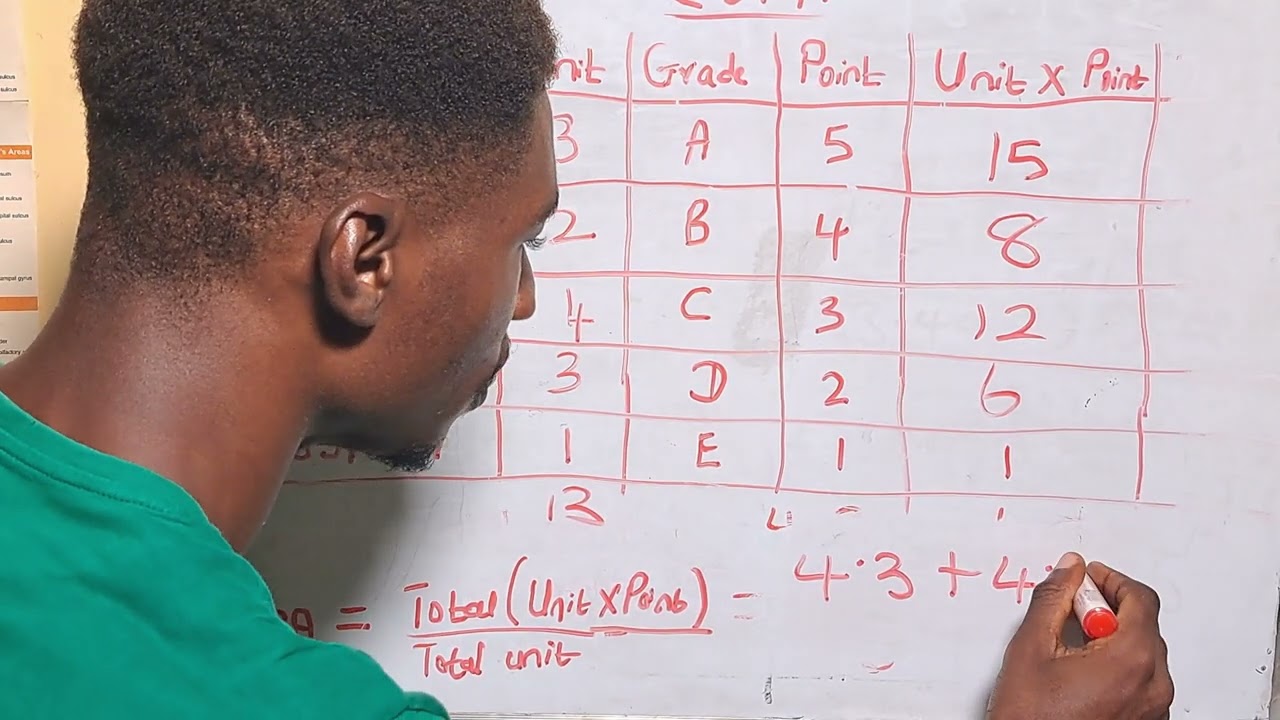
The standard NUC grading structure breaks down as follows:
- A (70 to 100 percent): 5.0 points
- B (60 to 69 percent): 4.0 points
- C (50 to 59 percent): 3.0 points
- D (45 to 49 percent): 2.0 points
- E (40 to 44 percent): 1.0 points
- F (0 to 39 percent): 0.0 points
Students can review comprehensive guidelines and framework definitions through resources like the University of Ibadan official notice on grading system and CGPA ranges. Always confirm specific institutional guidelines to ensure calculations align with internal university policies.
How to Calculate Your Semester Grade Point Average
Your Grade Point Average measures academic performance for a single, specific term. To compute it accurately, you must understand two foundational terms. Credit units represent the weight or workload of a specific course, while grade points correspond to the grade earned.
The step by step calculation process involves four straightforward actions:
- For each individual course, multiply the earned grade point by the credit units to determine the quality points.
- Sum up all quality points earned across all courses taken in that semester to find your total quality points.
- Sum up all credit units for those exact same courses to find your total credit units.
- Divide your total quality points by your total credit units, typically rounded to two decimal places.
Worked Example for Semester One
| Course Code | Credit Units (CU) | Grade | Grade Point | Quality Points (CU times GP) |
| Course A | 3 | A | 5 | 15 |
| Course B | 4 | B | 4 | 16 |
| Course C | 2 | C | 3 | 6 |
| Course D | 3 | B | 4 | 12 |
| Total | 12 | Not Applicable | Not Applicable | 49 |
Applying the formula involves dividing forty nine by twelve, which yields approximately 4.08. Detailed calculation breakdowns and walkthroughs can be explored further in this detailed guide with worked examples and formulas.
How to Calculate Your Cumulative Grade Point Average
While your semester GPA reveals performance in a single term, your Cumulative Grade Point Average reflects your overall academic standing across every semester completed up to the present moment.
Calculating your CGPA does not involve averaging your previous semester GPAs together. Instead, you must pool all raw academic data:
- Sum all total quality points from every semester you have completed.
- Sum all total credit units from those exact same semesters.
- Divide the grand total of quality points by the grand total of credit units.
Multi Semester Worked Example
- Semester 1: Total quality points equals 66, total credit units equals 17, yielding a GPA of 3.88.
- Semester 2: Total quality points equals 56, total credit units equals 18, yielding a GPA of approximately 3.11.
To find the cumulative standing after these two sessions, add the quality points together and divide by the sum of the credit units. The calculation becomes 122 divided by 35, which equals an approximate CGPA of 3.49.
Because of this cumulative nature, higher credit unit courses weigh much more heavily on your final standing. A high grade in a heavy course provides a massive boost, just as a poor grade pulls down your average drastically. You can review official documentation detailing this computation on the UNN official page detailing GPA/CGPA computation and degree classifications.
Degree Classifications on the 5.0 Scale
Your final cumulative standing determines your degree classification upon graduation. While cutoffs can occasionally vary based on faculty senate approvals or specific institutional policies, the common NUC ranges are:
- First Class Honours: 4.50 to 5.00
- Second Class Upper Division: 3.50 to 4.49
- Second Class Lower Division: 2.40 to 3.49
- Third Class: 1.50 to 2.39
- Pass: 1.00 to 1.49
Falling below a 1.00 cumulative average typically leads to academic probation or outright withdrawal from the university program. Additional reference data regarding these benchmarks is available via this comprehensive overview of NUC 5 point scale and degree classifications.
Proven Strategies to Improve Your Cumulative Standing
Improving a struggling average or maintaining a strong standing requires deliberate effort and strategic resource allocation. Because every grade permanently anchors into your cumulative record until graduation, you must manage your academic workload with clear priorities.
- Master Continuous Assessment: Most university courses allocate thirty percent of their total score to continuous assessments, which include tests, practicals, projects, and assignments. Missing tests creates an uphill battle that a high exam score alone struggles to fix.
- Prioritize Heavy Courses: Focus intense preparation on high credit unit courses. Scoring an upper grade in a heavy course yields a massive injection of quality points compared to a similar grade in an elective.
- Engage Early and Consistently: Attend lectures regularly and seek clarification from instructors immediately when difficult topics arise rather than waiting until the eve of examinations.
- Clear Carry Over Courses Promptly: Failed courses drag down your cumulative totals continuously. Retake and clear them at the earliest available opportunity to stabilize your average.
- Set Realistic Targets: Calculate what GPA you need in upcoming terms to reach your cumulative goals. Tracking your trajectory keeps you grounded and motivated.
- Leverage Technology: Utilize reliable digital tools and academic projection platforms such as those outlined in this step by step explanation with practical tables and examples to run scenarios before official results are released.
Many students who face a rocky start in their early years manage to completely turn their academic standing around by applying disciplined study habits and a focused mindset.
Disclaimer: Academic regulations, grading policies, and classification boundaries can vary by institution. Always verify your specific university student handbook and consult your departmental academic advisers to ensure complete accuracy regarding your degree requirements.
Leave a Reply